
Hiergeist

Bruce’s obsession with ghosts had taken hold well before he’d flushed his first goldfish or buried the family hamster in the backyard. A good six years before his uncle’s slow death.
The problem, as far as it could be traced, originated with Mr. Boltzmann, his second-grade science teacher who, in his efforts to spark curiosity and fascination, had a habit of introducing his students to concepts that were often beyond their abilities to grasp.
“Our brains only evolved to perceive and understand the things that help us survive here on this planet,” he explained. “But there is a whole universe out there. It may have no limits. No end. Who knows what things could exist, even right here, all around us, that we can’t see. Things we can’t even imagine!” He clomped across the classroom floor, hair wild, trailing a cloud of chalk dust. “So, maybe when we die, we aren’t really gone, we’re just somewhere else. Somewhere that we can’t detect with our puny, narrow senses.”
Mr. Boltzmann had unwittingly opened a door to cosmic possibilities, and for Bruce, it swung wide.
By age fourteen, he had absorbed books on hauntings and the occult, seances, demonology. Exorcism. During all this, his mother made vaguely discouraging comments while abusing Zinfandel and pickleball in roughly equal measure. His father had checked out completely in the wake of his only brother’s death, turning grief into a full-time job. He set up camp on the basement couch and seemed content to ride short-term disability out as far as it would take him.
The family of three lived in their collective dazes until a failing grade in freshman physics landed them in a school office the size of a closet.
“Have you considered taking a little family trip,” the guidance counselor asked.
“I don’t know,” his mother quibbled, “the weather is turning colder now.”
“I really do need to get a new batch of disability forms turned in,” his father said.
“Take a trip.” The counselor nodded her head and then snapped a heavy ledger shut on her desk to indicate that the command was not open for debate.
•
It was his father, Ron, who had suggested that he and Bethany take their floundering son to Arrowhead Lodge, deep in the Shawnee State Forest, having spent time there with his brother during their childhood living along the Ohio River.
“Leaf-peepers,” Ron said, keeping his focus on the winding road ahead.
“Leaf-peepers?” Bruce watched a horizontal strip of his father’s face reflected back at him in the rearview.
“That’s what the website called it,” Bethany explained, “when folks make a trip out to the woods to see the fall colors.’”
“Oh. I see. Because we’re peeping at leaves.” He allowed a moment to pass, the dark trunks and rusty foliage whipping past the window. “Do you know how old this lodge is?”
The couple were unskilled in subtlety, casting anxious looks across the console at each other before Bethany said, “why do you ask, hon?”
“No reason.”
“Bruce,” Ron said, “let’s try to stay here in the land of the living this weekend. Okay?” And then, before he could be rebuked himself, added, “that includes me too, just so we’re clear.”
“I will,” he said, then uncrossed his fingers, wondering to himself how these people who were supposed to know him better than anyone in the world could bring their ghost-crazy child to a sprawling old lodge in the middle of thousands of acres of primal forest and expect him leave all thoughts of the netherworld behind.
•
The sun, strobing swollen and red through the trees, had merged with the horizon by the time they spotted any road signs for Arrowhead Lodge. The parking lot was the size of a football field, cracked and gray and empty but for a few scattered vehicles. Even at dusk, the trees all around blazed as if painted by flame.
Ron parked in the spot nearest to the entrance and they gathered up their things from the trunk. A creeping chill licked at exposed necks and ankles. In every direction, the rolling golden hills appeared to stretch to infinity.
“This place is amazing,” Bethany said, for once striking an unironic tone. “Come on, let’s see if the restaurant is still open. I need a bite and a drink after that ride.”
She found her drink, and a few others, in the Smokehouse Grill just off the main lobby. They worked out a vague itinerary for the next day that included a trail hike and a trip into town, all while picking over fried chicken and limp salads. The lodge was largely abandoned in the late season and the clerk at the desk offered them a suite for the price of a regular room which his parents accepted with only mild suspicion.
Ron tested out the couch. It seemed to meet the sleeping standards that he had grown accustomed to. Bethany turned to a cooking competition on TV and got under the starched bed covers to sip at a glass of chardonnay and scroll on her phone.
Behind the locked bathroom door, Bruce flipped through the pages of a book called Haunted Ohio, having hidden the contraband inside one of his suitcase’s many pockets. At midnight, he checked the main bedroom to find his parents lost in their separate slumbers.
A key card in his pocket, he stepped out into the dimly lit hallway and let the door close softly behind him. While the place had its modern flourishes—fresh paint on the walls, showers tiled in natural stone like something from an HGTV show—its old bones were still exposed. He passed below wooden beams, feet treading quietly on patterned carpet worn thin down the middle of the halls.
He saw no other guests entering or exiting rooms, no trays of half-eaten food left outside of doors, yet the scent of a billion dead cigarettes and spilled drinks haunted every space. The passages ran for what felt like miles before taking strange turns at bizarre angles, seeming to double back on themselves. Eventually he passed through a set of creaking doors and entered the enormous lobby.
A cathedral of timbers and stone, the main hall surrounded a soaring hearth, still blazing with the day’s fire. Only a few lamps had been left on by the night clerk, and they threw a pale orange light across the native American rugs and squat leather chairs, while the ceiling, four stories above him, was shrouded in darkness. The taxidermized corpses of fox and coyote, bear and bird, caught the light with their shining glass eyes, shadows stretching up walls that bristled with the ancient weapons used to kill them.
Bruce wandered a loose circuit through the lobby, taking in the murals and tapestries with their depictions of indigenous families grinding corn or skinning deer, showing off tooth-filled smiles and bloody hands. When he finally reached the reception desk, he waited until the woman, middle-aged and tired, turned from the tiny television she’d been watching and acknowledged him.
“Help you?”
“Hi,” he offered. “I was wondering—have you worked here long?”
“Oh,” she considered for a beat, “I been here seventeen years. Night shift the last five and a half. So, I guess so.”
He leaned a bit closer, his voice at a conspiratorial volume. “Have you ever heard any ghost stories about this place?” A familiar warmth bloomed in his chest as he anticipated phantasmagoric tales that would confirm, without doubt, the existence of an afterlife.
“Hmm. Can’t say that I know any off hand.” On the little TV screen, a gray Andy Griffith put his arm around a gray Opie. “Sometimes I hear that door to the Smokehouse rattling, like somebody’s coming in or out, but I go look and nobody’s there. That like what you mean?”
“I suppose. Nothing creepier that you can think of?”
“Pretty creepy when you’re in here by yourself on a stormy night.” The woman scratched beneath a pendulous breast for a moment, lost in thought. “There was one time I was pulling the graveyard and I got a call from one of the rooms.”
“Oh, yeah? Had they seen something scary?”
“Well, no. There wasn’t anyone staying in that room. In the whole wing, matter of fact. I picked it up, just out of curiosity, and said ‘hello, front desk.’ I listened but didn’t hear anything. Not at first, anyway.”
“At first?”
“Right. It was just quiet. But then there was a whooshing sound, like wind, or like putting your ear to a seashell.”
“That’s definitely creepy. What did you do?”
“Called the damned cops. They took their sweet time driving up here. I locked myself in the generator room and waited an hour before they showed. I didn’t want to be left alone here at the desk, so we all went to room 315 together. That’s where the call came from.”
“What was in there?”
“Nothing. But—and this still makes me feel like I’m going to have a heart attack just to think about it—the door was standing open.”
“Holy crap. Did you think it was a ghost?”
“No. I thought somebody was in the lodge with me. No ghost ever hurt me,” she looked past Bruce, into the dark corners of the hall, “but a few men sure have.”
Unsure of what to say to that, he simply shook his head. “Well, thanks,” he offered.
“You bet, kid.” She turned back to Andy. “Have a good one.”
Disappointed, he headed back toward his room, a journey that first took him through the lobby to a floating staircase of wood and black steel, but before he reached the first riser, he noticed an old man seated in a high-backed rocking chair, the glow of the fire illuminating his withered face. Bruce stood, hand on the railing, watching the motionless man for any sign of life. Just before giving up and taking the dark halls back to his unconscious parents, he was stopped by a voice, high and musical.
“Gute nacht.”
He took a step toward the hearth and the chair that sat empty between he and the man. “What?”
“It means goodnight. In Austrian.” His accent wrapped each word in gravitas, but the English underneath was still discernible.
“Thanks. Yeah, you too.” He moved to the stairs again, picturing the deep grooves in the man’s brow and imagining the knowledge that those decades of life must afford a person. “Say, I was talking to the clerk around the corner about ghosts. It’s kind of a hobby of mine. Any chance you’ve had experience with that kind of thing?”
The man’s head, haloed in gossamer fuzz, rotated slowly, as if any motion at all required great effort. A bony hand rose from his lap and toward the vacant rocking chair. Bruce sat and was embraced by the heat of the crackling flames.
For a long moment, the old man said nothing, leaving Bruce to wonder if dementia might prove to be a barrier to any fruitful conversation.
“Ja,” he finally spoke. “I have seen the ghost. I know its face.”
This jarred him, turning his hands moist and his throat dry. “The ghost? What ghost?”
The skeletal face turned back to the fire. “There is only one ghost.”
“What is it?”
“Look around you.”
The rocking chair creaked as Bruce twisted, craning his neck to see between the beams and into the hidden reaches of the great hall. “I don’t see anything. Do you?”
“If you have eyes, then you see the ghost. It’s name is Hiergeist. The Ghost of Here.”
“Is that like an Austrian myth or something?”
“It is the reality of this existence.”
“I don’t get it.”
The man nodded almost imperceptibly and then was silent for a beat, as if looking for the right words.
“When you think about the past,” he said, “the memories you have do not necessarily represent reality. They are nothing but the firing of neurons in your brain. The neurons and chemicals that create those memories are made of atoms that are arranged in a particular configuration. Correct?”
“I guess so.”
“So, imagine that I had a very special machine, one capable of identifying the position of every last particle in your brain, right at this moment, and then I used this machine to recreate that exact pattern out of a collection of spare particles, like building blocks. In that case, the brain I construct would have the same memories as you do, even though it never actually experienced them directly.”
“That does kind of make sense,” he said, acid swirling in his gut.
“Indeed. The rest is simply an issue of probability.”
“What do you mean?”
“When you consider our universe—stars, planets, humans—where do you think it all came from?”
Bruce hesitated, wary of a possible trick question. “The Big Bang?”
“Perhaps. The story that you know, that you remember knowing, starts with a singularity that suddenly expanded, dragging space and time behind it, and goes on to the development and destruction of countless stars, then the spark of life, guided through the eons by natural selection, and all the way down through history to this exact moment.” His thin lips twitched, almost a smile. “But there are other paths to now.”
“But how else could we have all this? Where else could it come from?”
“Something like the Big Bang may have once occurred, but it was not thirteen billion years ago as you recall being taught. It was instead many trillions of years in the past. Since that time, the universe has expanded out further and further into a state of heat death. From the Big Bang, to the Big Freeze.” He leaned slowly forward in his chair. “The truth of the universe, of physical reality, is that of an infinite field of cold particles and evenly distributed energy. But here is the strange thing about infinity—even in this unending void of nothingness, quantum fluctuations still occur, allowing particles to occasionally come together in random mixtures. A sparrow, for instance popping into existence, fully formed. It may take a length of time that is impossible to imagine, but when you have eternity, eventually everything that might happen will happen, and an infinite number of times at that.”
“Wait, are you saying that this whole world just happened to form out of a bunch of electrons and neutrons and stuff?”
“That is possible. An entire universe can arise in this way, but just as it is much more likely to drop lettered tiles on the floor and get a single word than a whole sentence, the chances of randomly ending up with a complex universe, or a solar system, or even a planet are very low. What is more likely than any of them is the spontaneous generation of a single human brain, complete with all the memories of having been a teenage boy on a planet called Earth.”
Bruce recognized that he was shaking. He crossed his arms to still them. “So, you’re saying that all the memories I have, the photos and videos of growing up, the drawings and school papers I did, the time last month when Tamara Holt kissed me on the mouth, none of that actually happened?”
“It is impossible to know at what point in your timeline your brain materialized, a complete history built right into its makeup. Impossible to know which of your memories occurred in this reality and which are just the pattern of particles in your hippocampus. But the mathematics say it is much more probable that you, me, all of this has only been in existence for a moment.”
“How would I know if I’m just a brain floating in space though?”
“Well, in the timeframe that your brain does exist, your experiences would most likely become increasingly unusual, misaligning with the memories and expectations that were set in motion when it spontaneously emerged.” He appeared to wink. “Things would start out normal, but they would soon get weird.”
Jaw hanging low, Bruce sat back against the smooth wooden slats, his mind, whether fourteen-years-old or fourteen seconds, was whirling with anxiety and confusion.
The old man turned to face him again, the firelight dancing in his watery eyes. “Just as the particles that are generating your current thoughts and feelings came together randomly, and probably just seconds ago, they are fated to decay, to move on, to drift apart and return to the vast field of eternity. This is why your reality is but a specter. Hiergeist. We are destined to become the Ghost of Here.”
Bruce was up then, the heat of the fire like a hand against his cheek. He needed to be away from this man, from his foreign voice and harrowing thoughts. He felt an urgency to get to his room, to his parents, as if he might somehow disintegrate before reaching them.
“I gotta go, mister. That was—uh, like, a good story. Thanks.”
“Auf wiedersehen, mein kind.”
He spun around the corner and took the stairs two at a time but stopped when he reached the first landing, just out of the old man’s sight. Questions were beginning to bubble up from his subconscious, insisting on answers.
“Hey, mister,” he said, descending to the lobby once again, “how do you even know that the universe is infinite. How do you know any of—”
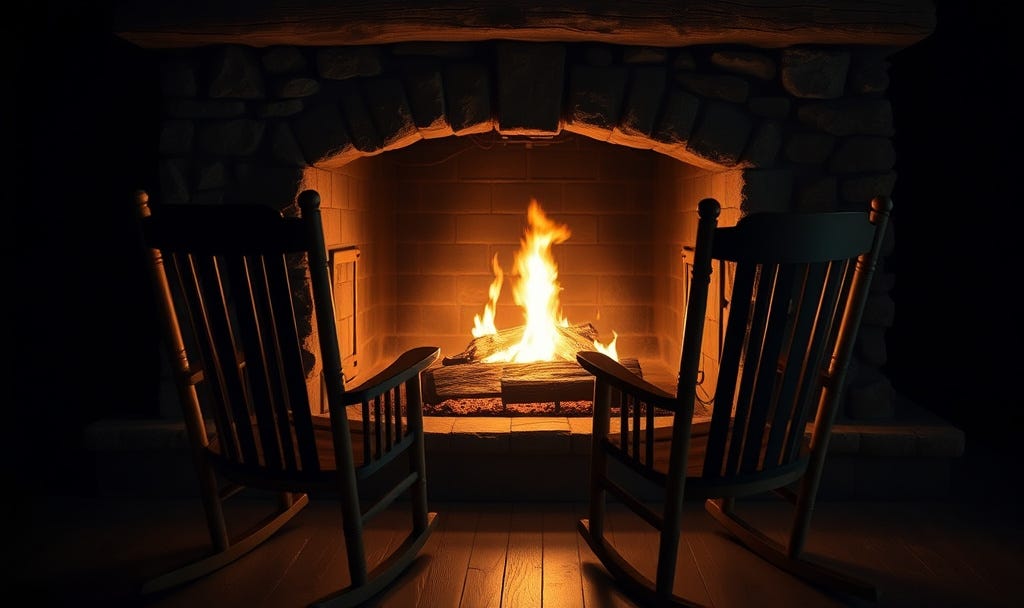
His feet seemed somehow attached to the polished hardwood, legs growing icy and numb. A draft cooled his reddened face as he stared in shock at two empty rocking chairs arranged before a dead fireplace, dark with cold ash.
•
The walk back to his room was haunted by the words, all those crazy, rambling, inescapable words. They groaned at him from the rafters and lunged from unoccupied rooms.
He slipped the keycard through the slot and let himself in, grateful and amazed to exist even a moment longer, his mind held together in the eternal void by nothing but the forces of chance.
•
I really enjoyed this. It reminded me of an E.F. Benson or an M.R. James, but with a more modern understanding of popular physics. There is almost an Aquinas element to it, touching on the scientific creation theories, but it follows the traditional late Victorian ghost story narrative. I had read it before, but didn't comment last time. Thanks for pointing this out again.
Well, he said that we're only here for a moment and so he was. Hehe. We all know that our time here is brief but this really delved into that and now I feel even smaller than before. Haha. What a cool story, though. Great stuff, Layne.