
Endgam8
As soon as I learned of the mysterious phenomenon known as E8, I knew that I wanted to someday create a story about its cosmic weirdness.

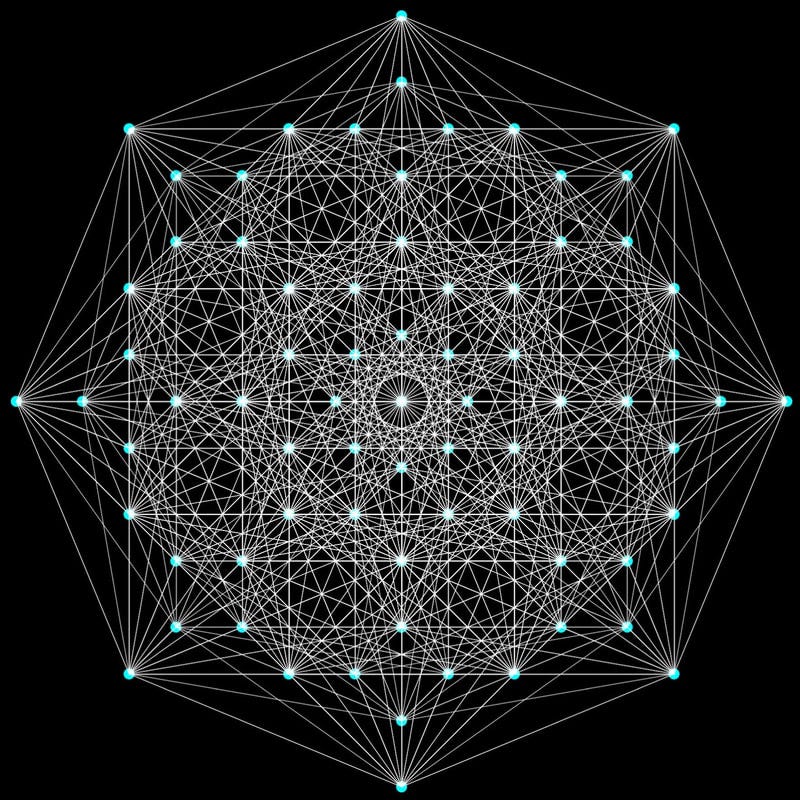
The annihilation of our entire universe began outside of Berlin, on a rainy January day in 1892, at the desk of the ironically named Wilhelm Killing. The process will reach its inevitable conclusion approximately six-hundred and thirty-eight days from now, which doesn’t mean very much numerically since, by then, time won’t really be working any more.
All this was hypothetical. Only equations on paper a century ago, and eventually just models in software. Until last May.
The 31st.
My birthday, actually. I never used to keep track of that kind of thing, which, it turns out, can make one a less than ideal spouse. And father.
“How many candles this year, Mike?” Carmen in data analysis can’t help herself.
“Just fifty-eight,” I smile. Don’t ask about the family, please.
Laurel divorced me twenty years ago for being a hopeless workaholic with alcoholism, or a helpless alcoholic with workaholism. Whichever way she’d put it, she was right. My only daughter, Rachel, kept her distance. We speak a couple of times a year, but I’ve still never visited her in New Mexico where she lives on a hundred-acre homestead, raising her two kids.
My grandchildren.
Strangers.
Sometimes I feel like I’ll never see them again and an urgency zips into me and I ask why I’m not fighting for them with what little fuel I have left.
Instead, I’ve spent every waking moment of the past seven years heading up the R-Branch of the SETI team out of Seattle, monitoring a section of deep space for re-radiated energy signals that could represent a Dyson Sphere—strong evidence of a Type II Kardashev civilization and a fast track to a Nobel Prize.
On that particular birthday, I was in the lab before sunrise. An odd batch of numbers had come in the night before that looked nothing like a stellar megastructure.
It looked like a software glitch.
Part of the algorithm used to determine the distance of any given candidate star includes a measure of the cosmological redshift. That number may vary but it is always positive because everything is always moving away from the source of measurement, which is us.
Earth.
I almost missed the little dash indicating a negative value. Somehow, the program had calculated a reversed critical density. I gave a barking laugh and the acoustics of the empty lab echoed back the cackle of a madman. The absurdity of that number was complete and total. The whole code would have to be combed through to find the error.
Because there simply had to be an error.
Otherwise, the data I was holding indicated that the stars and planets and galaxies in the observation field were suddenly blueshifted.
Which would mean that they are moving toward us.
The meat of the program consisted of one and a half gigs of code, but I knew the two dozen places to look for the kind of bug that might produce this goofy shit. After five hours, I had searched them all. Twice. No errors to be found. It was giving me a heavy feeling that I wanted to ignore.
To be honest, at that point, I wanted to start drinking again.
So, I did what five hours earlier I had put off, knowing all the while that I would end up doing it eventually. I repositioned the telescope to a completely different, randomly selected patch of space and waited twenty-seven minutes for a printout.
Blueshift.
Another random reposition.
Twenty-seven minutes.
Blueshift.
I hadn’t yet had enough time to truly accept the reality, but somehow, on paper at least, the universe had stopped its unrelenting expansion and was instead, for the first time in 13.4 billion years, collapsing.
Rapidly.
And that was only the beginning of the weirdness.
After I was done vomiting up the McGriddle and hash brown from an hour earlier, I did a quick internet search which yielded no indication that the blueshift was news. It was momentarily reassuring that perhaps the only issue here was that I’d had a stroke and that the universe outside my skull was actually still fine.
In the hurricane of thoughts that represented my brain’s effort to understand these circumstances, I kept coming back to my birthday. Without really thinking, I opened the trash folder for my work email.
15,389 messages.
One page down, slotted between a credit card offer and a link to a free trial of boner pills, I found the line that had gone to my mental graveyard, but hadn’t quite died.
Could perpetual motion be real? We’ll all know the answer on May 31st!
I hadn’t opened it yesterday, figuring it was just another piece of clickbait, but the combination of the date and the outrageousness of perpetual motion being a possibility had stuck with me like a digital hair in my throat.
It linked to a short article on Fokko Cartan, a mathematician and computer scientist in San Francisco who had been pioneering some rather far out methods in 3D printing. He claimed to be close to completion of a seven-month long project that he was convinced would culminate in the production of the world’s first perpetual motion machine.
I was instantly in debunk mode. Any kid who had taken introduction to physics knew that perpetual motion defied the laws of the universe. But then, so did the reversal of cosmological expansion. I wanted to know what exactly he was printing with that big 3D box of his.
There were no photos in the article, nothing to inspect or critique, and not much technical description of the project itself. The interviewer asked Cartan at one point when he thought the machine would be finished.
“Barring something like a nuclear bomb, the printing will be complete on May 31st.”
My birthday.
The man was asked what he called this perpetual motion machine.
“It is named after the exceptional Lie group that serves as the basis for the 3-dimensional construction. It’s called E8, and I believe it has the power to change everything.”
In that second, a nuclear bomb did, in fact, detonate, only it was in my head.
Twenty minutes later I was on the highway in my Civic, hauling ass down I-5 toward the Bay with my heart scraping against the inside of my ribcage and a Beretta 9mm in the glove box.
•
Excerpt from SF Chronicle article “Perpetual Notions” by Jeffery Lang-Steinberg
Jeffery Lang-Steinberg: Can you explain exactly what E8 is?
Fokko Cartan: Of course I can, but it is highly technical. Theoretical.
JLS: So, hard to put into words, huh?
FC: It’s more complicated than the human genome. Classification of E8 and associated simple groups has taken about 200 years and was completed in 2012. The proof is over 5000 pages long and is so complex that almost no one actually understands it.
JLS: That is wild! But what is it?
FC: It is a highly symmetrical lattice structure made of 248 points in eight dimensions that was discovered by Wilhelm Killing and other scientists around the turn of the century. It’s the most complex of all the Lie groups—that’s pronounced LEE—which are different groups of continuous symmetries where operations like multiplication and the taking of inverses vary smoothly enough that calculus can describe them.
JLS: Yeah, I think you can count me among the people who don’t understand it. I mean, if it’s this confusing and complex, why do people study it?
FC: It has applications in theoretical physics, especially string theory and supergravity. Some scientists believe that the structure of E8 could represent the key to a universal theory of everything. There are aspects of E8 that seem to describe all the different fundamental particles that are the most basic of building blocks. It is possible that we could use it to understand how the very clockwork of the universe functions.
JLS: That all sounds fascinating, but the question I have is this: What are you planning to do with E8?
FC: Before I’d ever heard of Lie groups or E8, I spent years working on the cutting edge of 3D printing technology. Not making spatulas or toys. More like solutions for printing customized medications. Proteins. Weapons.
I was perfecting a system for printing into substrates like water and oils, which could allow for the creation of a structure unconnected from any kind of physical base. Free-floating. When I went looking for something highly complex to attempt as my proof of concept, I learned about this most complicated of all structures and decided to aim high.
The recent explosion of artificial intelligence gave me the power to make a computer-generated model, perfect down to the smallest scale. I chose to print using the UHDP that my team and I designed and constructed two years ago. The Ultra-High Definition Printer can place one carbon atom at a time into the proper position in the model. Using carbon would make the real-life model of E8 nearly indestructible. The biggest hurdle at that point was finding the best fluid substance to print into, something that would allow the enormous model to float, perfectly suspended, all throughout the process of construction and to remain there after completion.
JLS: What did you come up with?
FC: There was only one option that fit the bill. Liquid argon.
It must be kept at exactly -302.4 degrees Fahrenheit. It takes two rooms of equipment to maintain the substrate within the perfect parameters. The tank holds 5400 gallons and is made of an aluminum silicate fused glass—the stuff used to manufacture the windows in space shuttles.
JLS: And you said that your version of a real-world model of the E8 structure is nearly finished?
FC: Yes. Only a week or so left in the fabrication phase.
JLS: What do you expect will happen then? What good can this multimillion-dollar fidget spinner do?
FC: I know that this will sound crazy to most people, but I think that the universe wants us to build E8.
JLS: The universe? Why would it want that?
FC: I don’t know. E8 has always existed, even if only theoretically. It has been patiently waiting for us, and now that I am bringing it into the physical world, I think that we will be rewarded with something magnificent. A complete paradigm shift in our understanding of the universe. It may create endless energy, ushering us into a future of abundance, peace. Heaven on Earth.
JLS: And what about the opposite?
FC: I don’t…I’m not sure what you mean.
JLS: I mean, what if it somehow destroys us?
FC: (laughs) Why would the universe do that?
JLS: It isn’t something you’ve even considered? That’s the whole point, isn’t it? That this thing is beyond anyone’s understanding? Couldn’t anything happen once it is born into the world?
FC: Yes. Anything could happen. I am prepared to accept the results, whatever they may be.
JLS: But what about the other eight billion people on the planet? What about their opinion? What happens to them?
FC: We will all soon find out.
•
I did debate about the gun for a while, but by the time I left for San Francisco, I knew that existence was screwed. If there was some tiny chance that I could still do anything about it, that I could stop it, I figured a gun would only help.
It was four in the morning when I got to his house. The address was right there at the top of the results page.
The neighborhood was dead, but there was a light in Fokko’s window.
I knocked.
Knocked again.
And there he was. He smiled as if he had been expecting me.
The smile fell away very quickly when I pointed the gun at his nuts.
“Inside,” I said.
He let me in, and I closed the door. Fokko went to the couch and sat.
“Who are you,” he asked.
“Shut up. The guy with the gun asks the questions. Don’t you watch movies?”
“I suppose you’re here because of E8.”
I leaned against a bookshelf, facing him. “Tell me what it’s for. Why you built it.”
“Philanthropy. Perpetual energy. To save the world from itself.”
“Bullshit.”
He feigned indignation. “What are you so suspicious about? You don’t even know me.”
“Because that thing you made isn’t doing fucking philanthropy.”
“How do you know what it’s doing?”
I explained what I had found at the observatory. I told him that I had read his interview and that I believed E8 was to blame. Needless to say, he remained doubtful.
“You should check your equipment,” he said, anger in his voice. “What you’re describing is impossible.”
“Like perpetual motion?”
That shut him up. For a minute, at least.
“Why are you here,” he asked. “What do you plan to do with that gun and that righteous attitude of yours?”
“I plan to stop this. If that’s still possible.”
“Listen,” he said “I’ve spent a decade of my life and millions of dollars on this project. It holds too much potential. All of humanity’s problems might be on the verge of eradication because of this one object. Please don’t do something to ruin it just because of some bad data and a paranoid delusion.”
Things weren’t going the way I had imagined. I stepped forward and punched him in the nose. He shrieked, clapping his hands over his bloody lump of cartilage, and immediately looked embarrassed by his reaction.
“Now, tell me why you really built it, or I start putting holes in you.” I thumbed the hammer back on the pistol. “We’re both dead men anyway.”
“What is your name,” he asked in his newly-nasal inflection, demeanor cooling toward the frigid.
“Michael.”
“No offense, Mike, you seem like a sharp guy, but that would be like explaining to a chipmunk why someone built a quantum computer. You just wouldn’t get it.”
Keeping the gun trained on him, I slid my phone from my coat pocket. The notifications had finally started and were stacked deep. I handed it to Fokko.
The guarded look melted from his bloody face, mouth and eyes widening as he read headline after headline.
CalTech Scientists Sound Alarm About Bizarre Findings
The Big Crunch! Could It Be Coming?
Physicist Quotes Bible: “This could be the Endtimes”
“Doesn’t mean the two are connected,” he said with no real conviction in his flat voice. His face was decidedly more pale. I took the phone back from him.
“I want to see it,” I said, the gun doing half the talking. “Clean your face off and let’s go.”
•
I made him drive. It was a short trip out of the city, past dark industrial buildings surrounded by warrens of tract houses and sandy lots of scrub brush. He turned onto a long, straight road with no markings, twice stopping to punch a code and watch a gate roll away from the asphalt. Finally, a complex of white, boxy structures blazed in the headlights. He drove around to the back of the main building and shut off the car.
He slid his seat belt off, but didn’t get out.
“Come on,” I said.
“You could still just leave. Just go home.” He sounded like a child, trying to bargain with no leverage. “You don’t know what you’re dealing with here.”
I said nothing. Moving slowly, Cartan shook his head and got out of the car.
As soon as he unlocked the service door and we stepped into the building, I could feel it. At first, I thought it was a sound. And in a way, my ears were detecting something, but the sound was coming from inside me. Like my bones were humming. It made my teeth feel like they were coming loose.
The temperature in the place was comfortable, but the air smelled cold. Sterile and cold.
“It’s this way,” he said, keying another lock. We stepped into a short hall that ended in a pair of glass doors. The buzz was louder. My joints were aching. There was a small metal box mounted to the wall and Fokko pressed the pad of his right thumb against its screen. There were beeps and clicks and then we were in the containment room and it was there with us. In front of me. The center of the universe.
“Go sit over there,” I told him, indicating an office chair off to the left. He obeyed. “Don’t get back up.”
I kept him in my periphery and stepped toward the tank in the center of the large, octagonal space. The fluid inside, the liquid argon, was so clear it was invisible. The sound of the object had changed. It was no longer a monotonous buzz, like the greased bearings of some gargantuan turbine.
Now it was singing.
At least seven feet in diameter, it was not the gray-black ball of carbon that I had envisioned. Perhaps it had once been, but what hovered behind the glass was something that my mind was not evolved to understand.
It was spinning. Spinning in two-hundred and forty-eight different directions at once. And then it wasn’t. The smooth rotations cancelled each other and the thing hung there, completely motionless, a rainbow shimmer swirling across its silver surface. Faces formed and melted and formed again. Tiny spikes jutted outward in complicated patterns, more and more of them, like cities rising and falling across a miniature Earth.
“What is it doing,” I asked.
Fokko said nothing.
I sensed the energy it was generating, imagined the burning power that could be harnessed and used, just like he’d said in the interview. At that instant, a rose-gold glow spread over it in venous branches, molten rivers flowing all around its circumference, welling up from deep within its infinite lattice. It occurred to me that I might have already been irradiated by the thing, my cells mutating and metastasizing right where I stood. As if on cue, the glow became a sickly green, pulsing with malignant force.
“It’s reacting to my thoughts, isn’t it?”
“Observer effect,” he said from his chair. “It’s probably impossible for us to see its true form because it exists in eight dimensions. In a sense, we are looking at it, and we are inside of it, and it is inside of us all at the same time.”
“What happened when you finished building it yesterday. What happened when it was done?”
Fokko leaned forward, elbows on knees. “It was just sitting there at first. Totally inert. Black. Glossy black. Incredibly beautiful. Almost…hard to look at. So complex my eyes wouldn’t focus on any one part of it. Then, it spoke to me.”
“It spoke to you,” I repeated. “Well, don’t leave me in suspense. What did the giant ball of doom say?”
“It told me, showed me, what it really is.”
I wasn’t entirely sure that I wanted to hear what he had to tell. He stood slowly from his chair. I lifted the gun.
“It’s the end.”
No. Definitely not what I was hoping for.
“The truth is,” he said, “that even if you could stop it, and even if that did prevent the collapse, it would only delay the inevitable. Someone else, a human, an alien, some life form a billion light years away, would eventually build this again. It is a cosmic reset button, built into the fabric of every iteration of the universe. It is the ultimate Easter egg. The hidden line of code. It’s God’s endgame. Once any intelligence becomes advanced enough to figure it out, to create it, that means it’s time to start over.”
Cartan’s eyes were wide, manic. “You should be celebrating, man. Out of all the trillions of galaxies in the universe, homo sapiens did it. We won. No one can stop the destruction of everything. It’s baked into the equation. Inescapable. The only thing you can do, the only thing each conscious being can control, is how they face their fate. That’s as close to free will as any of us is ever going to get. The button has been pushed but we have a little time left. How you spend it is the most important choice of your life. The most important choice ever.”
His words shook me. My mind couldn’t square it. Wouldn’t accept it.
“No. It can’t be. If that’s true, I can’t just let this continue. I told you. I have a daughter. Grandkids. They have a future.”
“There is no future now.”
I didn’t take time to aim. The tank was so big, I only needed to turn 90 degrees and pull the trigger. The gunshot made a brutish, concussive pop. The special glass did not shatter, but a crystalline crack spread out from the site of the impact.
“Stop! You don’t know what you’re doing!” Fokko took a step toward me, toward the gun, then stopped himself, still not wanting to be shot despite the impending destruction of all life.
I rotated the barrel back to the tank. Back to E8.
A number of things happened all at once.
I dove and pulled the trigger. The tank burst. I landed on my side behind a bank of dials and monitors. A hundred-thousand chunks of fused glass exploded in all directions like a miniature version of the Big Bang, shredding through everything in their path.
Cartan was dead before all the pieces of him had hit the floor.
The liquid argon flooded out, splashing and hissing. I jumped up and ran so wildly that I fell over a chair. I gave up fighting and let myself lay on the concrete, bracing for the icy fluid to crystalize me.
When it did not, I was relieved to see that the argon, at room temperature, had instantly become huge clouds of blueish gas. I took a quick breath and held it.
Still, I waited. I stood and took a last look at the object. At E8. It seemed bigger, much bigger than the tank had been. A ball of the most intense white, it was brighter than a billion suns, but its light did not burn me and did not hurt my eyes. It was motionless, but also spinning and collapsing and expanding.
I fired one last shot and could not even hear it in the maelstrom. The cosmic death machine was clearly going to carry out its purpose with or without me.
Before I could learn what pure argon gas would do to a pair of human lungs, I limped to the door, back down a few hallways, and out to the parking lot where Fokko’s car sat waiting.
•
Driving in the night, I helplessly watched my mind as it sifted through the paltry scraps of physics left in mental storage from my days in grad school, searching for explanations. Needing answers. Solutions.
Some effect on dark energy?
Entanglement?
God?
I knew that it was unknowable. Unstoppable. I glanced at the gun laying in the passenger seat more than once, but left it alone.
I didn’t know where I was going at first. I didn’t turn back north, choosing instead to just drive aimlessly for a while.
The button has been pushed but we have a little time left. How you spend it is the most the most important choice of your life.
My subconscious must have taken over because I eventually noticed an on ramp for I-40 East toward New Mexico, my hand going to the blinker as if pulled by a magnetic force. A hundred and thirty-nine miles out from Oakwood. From my daughter and those grandkids.
The sun eventually came up ahead of me, so red and round on the desert horizon, just as it had every morning for billions of years.
Somewhere between Belmont and Flagstaff, the first golden rays warmed the Beretta where it lay in the roadside grit, patiently awaiting its ultimate fate, just like the rest of us.
•
From the journal of Wilhelm Killing, June 1, 1916
All then became one. Every raging supernova, every spiral galaxy, every photon and water molecule and chair and neuron and even time was reeled back in with such exponential suddenness and force that all were shredded and melted and vaporized and compressed until they became a single point so small and dense and hot that it became like nothing, surrounded by nothing, and pregnant with every possibility and all potential.
It rested there.
Nowhere.
Existed for no time and forever.
Still and roiling.
Nothing.
Then, sound with no one to hear it.
Light with no one to see it.
Heat with nothing to burn but itself.
This infant universe burst away in every direction as it created direction, over intervals of time as it forged time. A uniform field of plasma slowly obeying the will of gravity as gravity itself began to congeal out of the blazing ether.
Over vast expanses of time, that inexorable web of gravity collected particles until the clouds were crushed in upon themselves by its power. The impossible pressure triggered fusion reactions, building massive furnaces that would cook for small eternities, creating in their depths an array of elements until finally these stars collapsed and exploded, spewing their tiny creations out into the void to follow the laws of physics until they had the opportunity to form water, and then life, and then intelligence enough.
Enough for the universe to see itself.
To kill itself.
And to birth itself once again.
•
Last year, I began sharing a weekly post about the story I’d come up with for that week, along with some of the writing strategies I had been contemplating. Below is the post that accompanied the creation of this story.
The Lynchpin

I had a couple of false starts for story #35. I seemed to be facing the same problem that I ran into over the last couple of weeks. It started when I recently read a quote from Dean Kissick’s Harpers article in which he wrote, “I like art the most when it doesn’t mean a thing, or otherwise when its beauty or strangeness transcends its subject. Art is be…
Layne!
I mean the highest praise when i say your writing struck me as a more verbose Warren Ellis and a more eloquent… umm, me.
That story is 💯 my jam.
fantastic! 🤪😁🤔🫡